 Add to Chrome
 Add to Firefox
 Add to Edge
CASE-NET: Deep Spatio-Temporal Representation Learning via Causal Attention and Channel Recalibration for Multivariate Time Series Classification
May 21, 2026
Multivariate time series (MTS) classification is foundational to pervasive computing and financial analysis, yet existing multi-scale paradigms are often constrained by suboptimal representation fidelity. We identify two critical bottlenecks: temporal non-causality in standard encoders that induces temporal confounding in non-stationary dynamics, and the absence of explicit channel saliency mechanisms that allows noise to contaminate the latent space. To address these challenges, we propose the Causal Attention and Spatio-temporal Encoder Network (CASE-NET), an architecture designed for structural manifold pre-conditioning. CASE-NET synergizes a Causal Temporal Encoder, which enforces physical arrow-of-time constraints via masked self-attention and causal convolutions, with an Adaptive Channel Recalibration module functioning as an information bottleneck to suppress detrimental noise. Comprehensive evaluations across six heterogeneous domains demonstrate that CASE-NET establishes new state-of-the-art benchmarks on four tasks, achieving a peak accuracy of 98.6% on the AWR dataset and superior robustness in non-stationary regimes.

SAMOFT: Robust Multi-Object Tracking via Region and Flow
May 10, 2026Multi-object tracking (MOT) is a fundamental task in computer vision that requires continuously tracking multiple targets while maintaining consistent identities across frames. However, most existing approaches primarily rely on instance-level object features for trajectory association, which often leads to degraded performance under challenging conditions such as object deformation, nonlinear motion, and occlusion. In this work, we propose SAMOFT, a robust tracker that leverages pixel-level cues to improve robustness under complex motion scenarios. Specifically, we introduce a Pixel Motion Matching (PMM) module that integrates the Segment Anything Model (SAM) with dense optical flow to refine Kalman filter-based motion prediction using instantaneous foreground pixel motion. To further enhance robustness under unreliable detections, we design a Centroid Distance Matching (CDM) module that performs flexible mask-based centroid matching for low-confidence or partially occluded observations. Moreover, a Distribution-Based Correction (DBC) module models long-tailed motion patterns in a training-free manner using historical optical flow statistics and dynamically corrects trajectory states online. We also incorporate a Cluster-Aware ReID (CA-ReID) strategy to improve the stability and discriminative power of trajectory appearance features. Extensive experiments on the DanceTrack and MOTChallenge benchmarks demonstrate that SAMOFT consistently improves baseline trackers and achieves competitive performance compared with recent state-of-the-art methods, validating the effectiveness of leveraging pixel-level cues for robust multi-object tracking.
TimeSAF: Towards LLM-Guided Semantic Asynchronous Fusion for Time Series Forecasting
Apr 14, 2026Despite the recent success of large language models (LLMs) in time-series forecasting, most existing methods still adopt a Deep Synchronous Fusion strategy, where dense interactions between textual and temporal features are enforced at every layer of the network. This design overlooks the inherent granularity mismatch between modalities and leads to what we term semantic perceptual dissonance: high-level abstract semantics provided by the LLM become inappropriately entangled with the low-level, fine-grained numerical dynamics of time series, making it difficult for semantic priors to effectively guide forecasting. To address this issue, we propose TimeSAF, a new framework based on hierarchical asynchronous fusion. Unlike synchronous approaches, TimeSAF explicitly decouples unimodal feature learning from cross-modal interaction. It introduces an independent cross-modal semantic fusion trunk, which uses learnable queries to aggregate global semantics from the temporal and prompt backbones in a bottom-up manner, and a stage-wise semantic refinement decoder that asynchronously injects these high-level signals back into the temporal backbone. This mechanism provides stable and efficient semantic guidance while avoiding interference with low-level temporal dynamics. Extensive experiments on standard long-term forecasting benchmarks show that TimeSAF significantly outperforms state-of-the-art baselines, and further exhibits strong generalization in both few-shot and zero-shot transfer settings.
UniSem: Generalizable Semantic 3D Reconstruction from Sparse Unposed Images
Mar 18, 2026Semantic-aware 3D reconstruction from sparse, unposed images remains challenging for feed-forward 3D Gaussian Splatting (3DGS). Existing methods often predict an over-complete set of Gaussian primitives under sparse-view supervision, leading to unstable geometry and inferior depth quality. Meanwhile, they rely solely on 2D segmenter features for semantic lifting, which provides weak 3D-level and limited generalizable supervision, resulting in incomplete 3D semantics in novel scenes. To address these issues, we propose UniSem, a unified framework that jointly improves depth accuracy and semantic generalization via two key components. First, Error-aware Gaussian Dropout (EGD) performs error-guided capacity control by suppressing redundancy-prone Gaussians using rendering error cues, producing meaningful, geometrically stable Gaussian representations for improved depth estimation. Second, we introduce a Mix-training Curriculum (MTC) that progressively blends 2D segmenter-lifted semantics with the model's own emergent 3D semantic priors, implemented with object-level prototype alignment to enhance semantic coherence and completeness. Extensive experiments on ScanNet and Replica show that UniSem achieves superior performance in depth prediction and open-vocabulary 3D segmentation across varying numbers of input views. Notably, with 16-view inputs, UniSem reduces depth Rel by 15.2% and improves open-vocabulary segmentation mAcc by 3.7% over strong baselines.
EEO-TFV: Escape-Explore Optimizer for Web-Scale Time-Series Forecasting and Vision Analysis
Jan 30, 2026Transformer-based foundation models have achieved remarkable progress in tasks such as time-series forecasting and image segmentation. However, they frequently suffer from error accumulation in multivariate long-sequence prediction and exhibit vulnerability to out-of-distribution samples in image-related tasks. Furthermore, these challenges become particularly pronounced in large-scale Web data analysis tasks, which typically involve complex temporal patterns and multimodal features. This complexity substantially increases optimization difficulty, rendering models prone to stagnation at saddle points within high-dimensional parameter spaces. To address these issues, we propose a lightweight Transformer architecture in conjunction with a novel Escape-Explore Optimizer (EEO). The optimizer enhances both exploration and generalization while effectively avoiding sharp minima and saddle-point traps. Experimental results show that, in representative Web data scenarios, our method achieves performance on par with state-of-the-art models across 11 time-series benchmark datasets and the Synapse medical image segmentation task. Moreover, it demonstrates superior generalization and stability, thereby validating its potential as a versatile cross-task foundation model for Web-scale data mining and analysis.
From Trial to Deployment: A SEM Analysis of Traveler Adoptions to Fully Operational Autonomous Taxis
Dec 31, 2025Autonomous taxi services represent a transformative advancement in urban mobility, offering safety, efficiency, and round-the-clock operations. While existing literature has explored user acceptance of autonomous taxis through stated preference experiments and hypothetical scenarios, few studies have investigated actual user behavior based on operational AV services. This study addresses that gap by leveraging survey data from Wuhan, China, where Baidu's Apollo Robotaxi service operates at scale. We design a realistic survey incorporating actual service attributes and collect 336 valid responses from actual users. Using Structural Equation Modeling, we identify six latent psychological constructs, namely Trust \& Policy Support, Cost Sensitivity, Performance, Behavioral Intention, Lifestyle, and Education. Their influences on adoption behavior, measured by the selection frequency of autonomous taxis in ten scenarios, are examined and interpreted. Results show that Cost Sensitivity and Behavioral Intention are the strongest positive predictors of adoption, while other latent constructs play more nuanced roles. The model demonstrates strong goodness-of-fit across multiple indices. Our findings offer empirical evidence to support policymaking, fare design, and public outreach strategies for scaling autonomous taxis deployments in real-world urban settings.
Effective Attention-Guided Multi-Scale Medical Network for Skin Lesion Segmentation
Dec 08, 2025In the field of healthcare, precise skin lesion segmentation is crucial for the early detection and accurate diagnosis of skin diseases. Despite significant advances in deep learning for image processing, existing methods have yet to effectively address the challenges of irregular lesion shapes and low contrast. To address these issues, this paper proposes an innovative encoder-decoder network architecture based on multi-scale residual structures, capable of extracting rich feature information from different receptive fields to effectively identify lesion areas. By introducing a Multi-Resolution Multi-Channel Fusion (MRCF) module, our method captures cross-scale features, enhancing the clarity and accuracy of the extracted information. Furthermore, we propose a Cross-Mix Attention Module (CMAM), which redefines the attention scope and dynamically calculates weights across multiple contexts, thus improving the flexibility and depth of feature capture and enabling deeper exploration of subtle features. To overcome the information loss caused by skip connections in traditional U-Net, an External Attention Bridge (EAB) is introduced, facilitating the effective utilization of information in the decoder and compensating for the loss during upsampling. Extensive experimental evaluations on several skin lesion segmentation datasets demonstrate that the proposed model significantly outperforms existing transformer and convolutional neural network-based models, showcasing exceptional segmentation accuracy and robustness.
URPO: A Unified Reward & Policy Optimization Framework for Large Language Models
Jul 23, 2025Large-scale alignment pipelines typically pair a policy model with a separately trained reward model whose parameters remain frozen during reinforcement learning (RL). This separation creates a complex, resource-intensive pipeline and suffers from a performance ceiling due to a static reward signal. We propose a novel framework, Unified Reward & Policy Optimization (URPO), that unifies instruction-following ("player") and reward modeling ("referee") within a single model and a single training phase. Our method recasts all alignment data-including preference pairs, verifiable reasoning, and open-ended instructions-into a unified generative format optimized by a single Group-Relative Policy Optimization (GRPO) loop. This enables the model to learn from ground-truth preferences and verifiable logic while simultaneously generating its own rewards for open-ended tasks. Experiments on the Qwen2.5-7B model demonstrate URPO's superiority. Our unified model significantly outperforms a strong baseline using a separate generative reward model, boosting the instruction-following score on AlpacaEval from 42.24 to 44.84 and the composite reasoning average from 32.66 to 35.66. Furthermore, URPO cultivates a superior internal evaluator as a byproduct of training, achieving a RewardBench score of 85.15 and surpassing the dedicated reward model it replaces (83.55). By eliminating the need for a separate reward model and fostering a co-evolutionary dynamic between generation and evaluation, URPO presents a simpler, more efficient, and more effective path towards robustly aligned language models.
ABG-NAS: Adaptive Bayesian Genetic Neural Architecture Search for Graph Representation Learning
Apr 30, 2025Effective and efficient graph representation learning is essential for enabling critical downstream tasks, such as node classification, link prediction, and subgraph search. However, existing graph neural network (GNN) architectures often struggle to adapt to diverse and complex graph structures, limiting their ability to provide robust and generalizable representations. To address this challenge, we propose ABG-NAS, a novel framework for automated graph neural network architecture search tailored for efficient graph representation learning. ABG-NAS encompasses three key components: a Comprehensive Architecture Search Space (CASS), an Adaptive Genetic Optimization Strategy (AGOS), and a Bayesian-Guided Tuning Module (BGTM). CASS systematically explores diverse propagation (P) and transformation (T) operations, enabling the discovery of GNN architectures capable of capturing intricate graph characteristics. AGOS dynamically balances exploration and exploitation, ensuring search efficiency and preserving solution diversity. BGTM further optimizes hyperparameters periodically, enhancing the scalability and robustness of the resulting architectures. Empirical evaluations on benchmark datasets (Cora, PubMed, Citeseer, and CoraFull) demonstrate that ABG-NAS consistently outperforms both manually designed GNNs and state-of-the-art neural architecture search (NAS) methods. These results highlight the potential of ABG-NAS to advance graph representation learning by providing scalable and adaptive solutions for diverse graph structures. Our code is publicly available at https://github.com/sserranw/ABG-NAS.
DeskVision: Large Scale Desktop Region Captioning for Advanced GUI Agents
Mar 14, 2025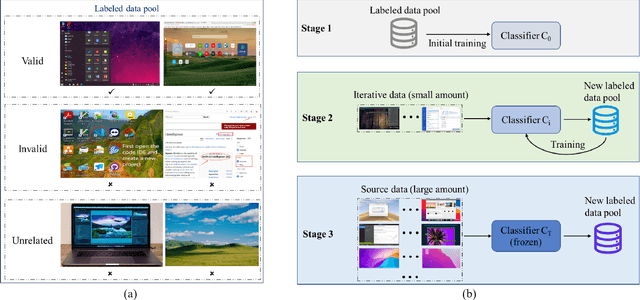
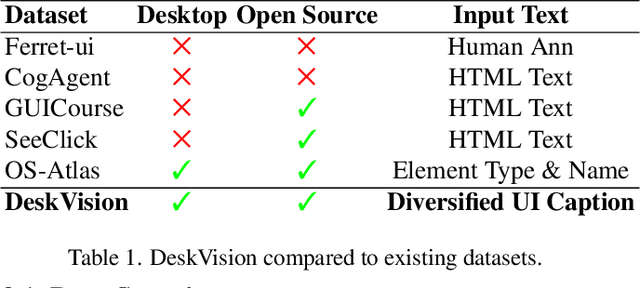
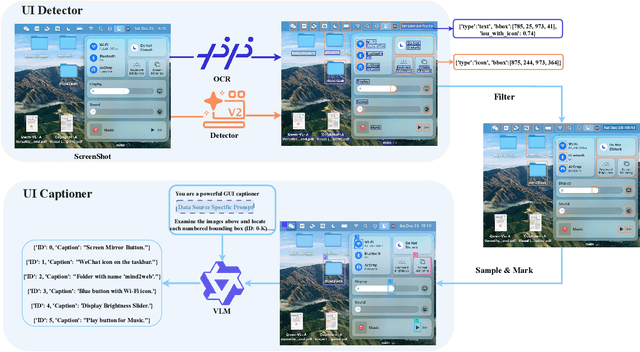
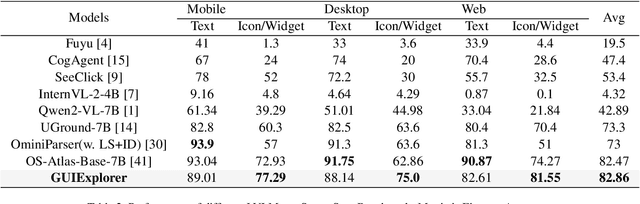
The limitation of graphical user interface (GUI) data has been a significant barrier to the development of GUI agents today, especially for the desktop / computer use scenarios. To address this, we propose an automated GUI data generation pipeline, AutoCaptioner, which generates data with rich descriptions while minimizing human effort. Using AutoCaptioner, we created a novel large-scale desktop GUI dataset, DeskVision, along with the largest desktop test benchmark, DeskVision-Eval, which reflects daily usage and covers diverse systems and UI elements, each with rich descriptions. With DeskVision, we train a new GUI understanding model, GUIExplorer. Results show that GUIExplorer achieves state-of-the-art (SOTA) performance in understanding/grounding visual elements without the need for complex architectural designs. We further validated the effectiveness of the DeskVision dataset through ablation studies on various large visual language models (LVLMs). We believe that AutoCaptioner and DeskVision will significantly advance the development of GUI agents, and will open-source them for the community.